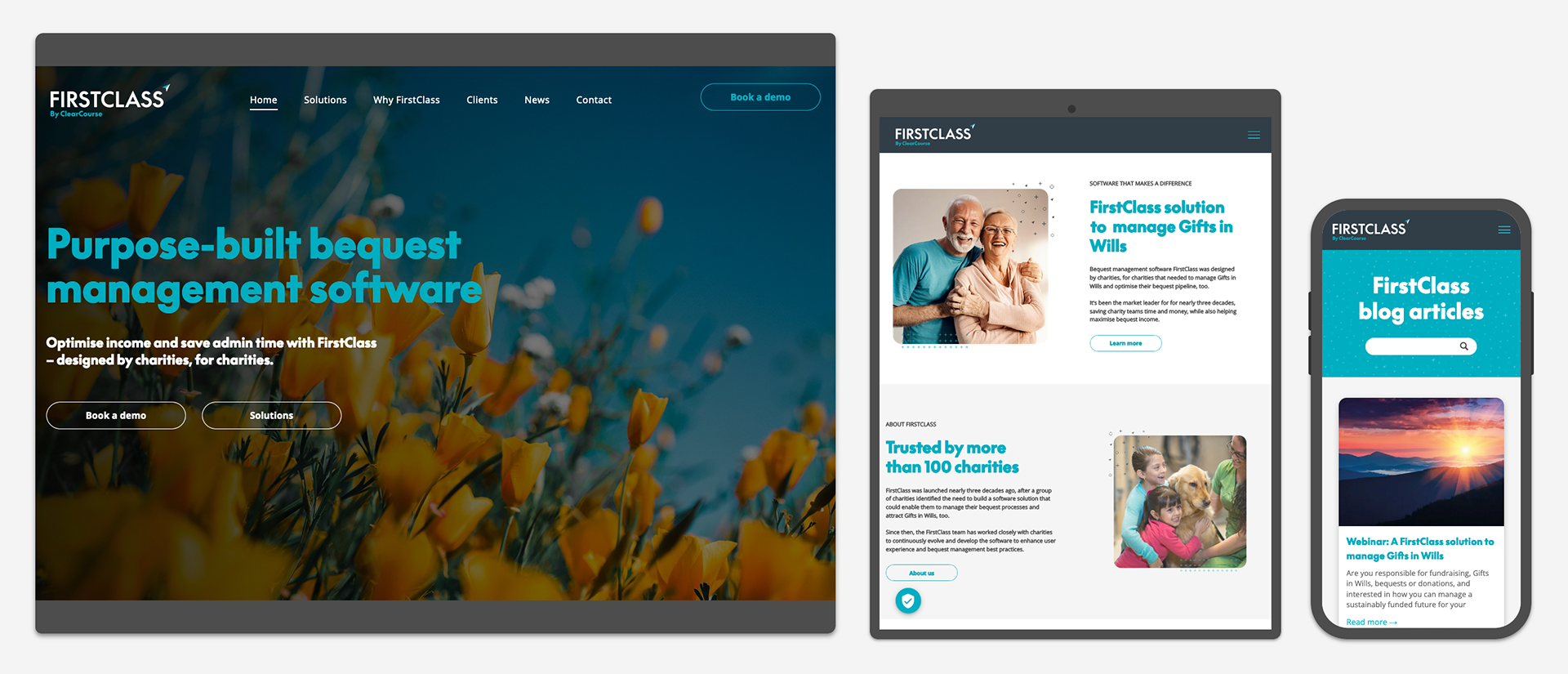
It’s here! Announcing our new FirstClass website

FirstClass is proud to announce the launch of our new website www.firstclass-software.com where we can collaborate and share useful information.


The main aim with our new site is to provide a space where we can share industry expertise, insights, pro tips for using FirstClass, and of course our latest news and events.


The site reflects our brand and positions us as market leader in bequest management software for estate administration for not-for-profit organisations.


We hope you’ll enjoy our intuitive layout that is user-friendly with streamlined menus, simplified navigation, and enhanced visual imagery. Combined with enhanced content and optimisation for mobile devices allowing for better interaction with FirstClass online.


We’ve also included some of the amazing charities we work alongside highlighting their journeys through case studies and testimonials in our dedicated client section.We hope you find the new website fresh and modern; we've worked hard to make sure it is designed to assist not-for-profit organisations in making well-informed decisions about the bequest management software.

FirstClass website device mockups

Rich Mullens, Product Director, is delighted with the new website: “The website has a new look and improved functionality to ensure an easier and more engaging experience for our users. The inclusion of our latest news section encompasses all announcements relating to events, blogs, and industry research thought-leadership pieces."


Celebrating nearly three decades of service excellence, FirstClass is the market leader saving charity teams time and money, while also helping maximise bequest income.


FirstClass was launched after a group of charities identified the need to build a software solution that could enable them to manage Gifts in Wills and optimise their bequest pipeline, too.


Since then, the FirstClass team has worked closely with charities to continuously evolve and develop the software to enhance user experience and bequest management best practices, with in excess of 100 not-for-profit organisations using it today.

By Fiona Paton July 6, 2026
UK legacy giving is at near-record levels. What the latest figures tell us, and what they mean for the sector. UK legacy giving brought in an estimated £4.4 billion in 2025, the second-highest year on record, according to the Legacy Giving Report 2026 from Legacy Futures and Smee & Ford. Only 2024's exceptional peak of £4.6 billion has exceeded it. By any measure, gifts in wills have become one of the most significant and reliable sources of voluntary income in the charity sector. Yet despite that scale, the opportunity remains largely untapped. Understanding why starts with looking at what the numbers actually say. A Sector at Scale The figures behind that £4.4 billion total tell a compelling story. Around 44,000 estates included a charitable gift in 2025, generating an estimated 104,000 individual bequests. The average gift value stood at £44,000, a sum that can be genuinely transformational for smaller organisations receiving even a handful of legacies each year. Perhaps the most striking figure of all is this: a record 17.4% of all estates at probate now include a charitable donation. That's nearly one in five. Legacy giving has moved well beyond a niche form of philanthropy. It is mainstream, growing, and showing no signs of slowing down. The Underinvestment Problem With legacy income accounting for 37% of all voluntary income to UK charities, you might expect it to command a proportionate share of fundraising attention. The reality is quite different. Research from the Charities Aid Foundation suggests charities spend around 15% of their fundraising budgets on legacy promotion, less than half what the income share would justify. That gap between income received and investment made is striking. It suggests that for many organisations, legacy giving is still treated as something that happens to them rather than something they actively cultivate. The gifts arrive. But the strategy, the stewardship, and the administrative infrastructure to support them are not always keeping pace. Concentration at the Top Legacy income is also unevenly distributed. For the top 1,000 legacy-receiving charities, gifts in wills account for around 30% of total fundraised income, a significant dependency. In the health sector alone, just eight major charities account for roughly half of all legacy income received. That concentration matters for two reasons. First, it reflects how much further the market could grow if more organisations, including arts bodies, heritage organisations, universities, hospices, and community charities, invested seriously in legacy fundraising and administration. Second, it highlights the competitive advantage available to those who do. The pipeline is there. The question is whether organisations have the capacity and the tools to manage it well. What Comes Next The outlook is positive. Annual legacy income is projected to approach £5 billion by 2030, driven in part by the ongoing transfer of wealth between generations. As legacy giving becomes an increasingly central part of the UK's philanthropic landscape, the organisations best placed to benefit will be those that treat it with the strategic seriousness it deserves. That means investing in legacy fundraising, yes. But it also means having the administrative foundations to handle every gift with the care and precision it warrants. The £4.4 billion figure is not just a headline. It is a signal. Sources: Legacy Giving Report 2026, Legacy Futures and Smee & Ford; Charities Aid Foundation UK Giving Report.
By Fiona Paton June 29, 2026
How our support portal keeps your issues moving, and nothing slips through the gaps. We introduced our support portal last year, and it’s made a genuine difference to how quickly and consistently we’re able to help. But we also know how organisations work: people move on, new team members join, and not every process gets handed over as smoothly as we’d all like. So, it felt like a good moment to set out how it works and make sure everyone on your team knows where to go. When something isn’t working the way it should, you want it sorted quickly. So do we. That’s why we’ve put a system in place that makes sure every support request gets the right attention from the right person, with nothing getting lost along the way. The Quickest Route to a Resolution The best way to raise a support issue is through our portal: www.firstclass-software.com/contact When you log a request here, a ticket is automatically created in our support system. You’ll receive a confirmation email with your ticket number straight away, and your issue goes into a shared team view that we review together every day. That daily review matters. It means the whole team has visibility of what’s open, what’s progressing, and, importantly, who is best placed to help. If one of us is tied up or away, your ticket doesn’t sit in a single inbox waiting. It’s picked up. Once Your Ticket Is Open Everything you need to do from there can be handled by email. If you want to add more detail, share a screenshot, or simply check where things stand, just reply to your confirmation email. Your response is automatically recorded against your ticket, so nothing gets separated from its context. Why We’re Asking You to Use the Portal We know it’s natural to fire off an email directly to someone you know on the team. We genuinely appreciate that; it speaks to the relationships we’ve built with you. But direct emails do carry a real risk: if that person is out, in a meeting, or simply gets busy, your message can sit without anyone else knowing it’s there. The portal changes that. The moment you log a ticket; the whole support team knows about it. It can be assigned, prioritised, and picked up by whoever can move fastest, and it’s there in front of us at every daily team meeting. It’s a small change in habit that makes a meaningful difference to how quickly and reliably we can help you. In Summary – Log support issues at www.firstclass-software.com/contact – You’ll receive a confirmation email with your ticket number – Reply to that email to add information or follow up; it all stays connected – Your ticket is visible to the whole team and reviewed daily – The right person picks it up, wherever they are If you’re ever unsure, or would rather talk something through, you’re always welcome to call us on 01257 272730. Articles like this, along with sector news, product updates and practical tips, are shared in our monthly newsletter. It’s something we’re often asked about: how do I sign up, or why am I not receiving it? So, we’ve created a dedicated page to make that easy. Visit www.firstclass-software.com/stay-connected to join, and please do pass the link on to any new members of your team.
By Fiona Paton June 18, 2026
Why smaller charities, arts and heritage bodies, and universities can't afford to manage legacies on a spreadsheet. Every charity that receives a legacy gift - whatever its size - carries the same responsibility: to honour that gift with precision, care and respect. The supporter who included your organisation in their will made a considered, generous decision. The way you administer that gift reflects directly on how seriously you take it. That's a truth that applies equally to a national charity managing thousands of cases a year and to a small arts organisation, university, or heritage body receiving a handful. The scale differs. The weight of responsibility does not. Yet many organisations in that second category are still managing legacy administration on spreadsheets. It's understandable - the volume feels manageable, the setup cost of dedicated software seems hard to justify, and there's a natural tendency to use familiar tools. But spreadsheets carry risks that are easy to overlook until something goes wrong. The Hidden Cost of 'Good Enough' Legacy administration is more complex than it looks from the outside. It involves tracking multiple cases simultaneously - each at a different stage, each with its own timeline, solicitors, correspondence and financial reporting. It requires a clear view of what income to expect, when, and how that maps against your organisation's plans. And it demands a clear, auditable record of every decision and communication. Spreadsheets can hold data. What they can't do is give you a real-time picture of your pipeline, generate reliable financial forecasts, or produce the audit trail that funders, trustees and regulators increasingly expect. When something is queried - by a solicitor, an executor, an auditor, or your own board - the answer needs to be immediate, accurate and documented. A spreadsheet rarely delivers that with confidence. There is also the question of what happens when the person who built the spreadsheet moves on. Legacy administration knowledge concentrated in a single file, maintained by a single person, is a fragile foundation for income that may represent a significant proportion of your organisation's voluntary revenue. "A lot of the organisations we speak to are managing perfectly well - they just don't realise how much peace of mind comes from knowing everything is audit compliant and in one place. FirstClass 5 Essentials gives smaller organisations the same professional foundation as the largest charities, without the complexity they don't need." - Bobby Parmar, Account Manager, FirstClass Built for the Scale You're Actually Working At FirstClass 5 Essentials is designed precisely for organisations in this position. It brings the same core capabilities that legacy professionals rely on - case management, financial forecasting, communications - in a version built for teams managing a smaller caseload. That means no unnecessary complexity. No features that exist to serve operations ten times your size. Just a clean, purpose-built system that gives you the visibility, compliance and confidence that spreadsheets simply can't provide. The practical benefits are immediate. A clear view of your pipeline and expected income. Case notes and communications in one place. And a record that holds up to scrutiny - because increasingly, it needs to. The Licence That Fits Unlike other software, FirstClass 5 Essentials doesn't require organisations to commit to bands of licences. If one person manages your legacy administration, one licence is all you need - with the flexibility to add more as your team grows. The investment required is smaller than many organisations assume. And when measured against the value of the gifts being administered - and the reputational and compliance risk of getting it wrong - it's rarely a difficult decision once the numbers are on the table. The Upgrade Path Is Always There Organisations change. Caseloads grow. Legacy programmes that start small can become central to a charity's income strategy over time. FirstClass 5 Essentials is not a ceiling - it's a starting point. As your organisation grows, so can your system. Upgrading when the time is right is straightforward, and everything you've built moves with you. You don't have to predict where you'll be in five years to make the right decision today. You just have to start with the right foundation. The Right Tool for the Work Legacy giving is growing. The Great Wealth Transfer is already underway, and more supporters - across a wider range of organisations - are including gifts in their wills. That trend makes the question of how those gifts are administered more important, not less.